
Free tool
CBM & Container Load Calculator
Calculate cargo volume, shipment weight and estimated container requirements in seconds.
- Mixed cargo in any units
- Checks space and weight
- Top, side and 3D loading views
- Free account for the full result and PDFs
Add cargo
Cargo list
No cargo yet. Add your first item above, or to see how it works.
Shipment total
- Total pieces
- 0
- Total weight
- 0 kg
- 0 lb
- Total volume
- 0.00 CBM
- 0.00 CFT
- Containers required
- –
- Add cargo to see options
A free account shows the CBM, the containers and the loading plan.
Have an account?
A free account shows the full result, saves your calculations and gives you PDF reports.
Container estimate
Recommended container options
Checked by volume and weight, piece sizes and stacking. Capacities are typical, approximate values: treat this as an estimate, not a loading plan.
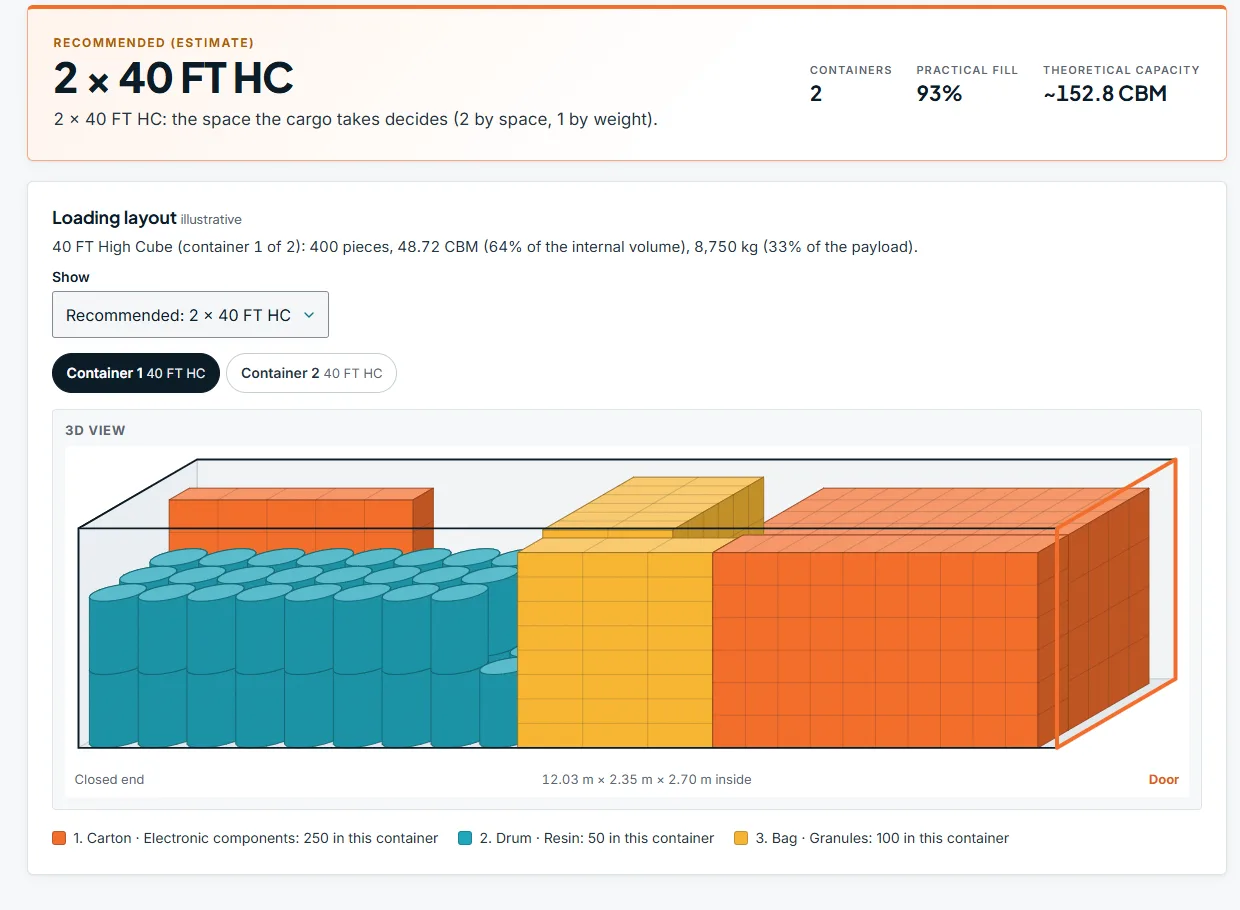
Loading layout illustrative
Your browser has 3D graphics (WebGL) switched off, so the interactive view is not available. The three views above show the same layout.
This picture loads the cargo row by row from the closed end to the door, largest pieces first, to help you see how the load could look. It is a simple guide, not an optimised stuffing plan: it does not plan weight distribution or securing, and a loading expert may arrange the cargo differently.
Loading summary
Theoretical vs practical capacity
Theoretical CBM capacity is the container's internal volume. Practical loading capacity is what usually fits once packing gaps, pallets and stacking limits are allowed for (the load factor). Actual container utilisation depends on cargo dimensions, stacking configuration and loading method.
All assumptions
Free account
Your container plan is ready
Create a free account, or sign in, to see the full result:
- Exact CBM and CFT for each line and the whole shipment
- The containers you need, checked by volume and weight
- Top, side and 3D loading views, and a 3D view you can turn
- Every container type compared, and a PDF report
Takes a minute. Your cargo list stays as it is, and the calculation is saved to your dashboard.
What you get
Your container plan, drawn to scale
Add your cargo above. With a free Farbe account you see:
- Exact CBM and CFT for each line and the whole shipment
- The containers you need, checked by volume and weight
- Top, side and 3D loading views, and a 3D view you can turn
- Every container type compared, and a PDF report
Farbe Enterprise
Need warehousing, logistics or 3PL support?
We arrange warehouse space across India, with our own warehouse in Ankleshwar, and run 3PL services: storage, pick and pack, cross-docking and dispatch coordination. Send us your calculation and we will get back to you within one working day.
What is CBM?
CBM means cubic metre (m³): the space taken by a box one metre long, one metre wide and one metre high. Shippers, freight forwarders and warehouses across India and worldwide use it to measure how much room cargo needs.
Sea freight for part-container loads (LCL) is usually charged per CBM, full containers are planned in CBM, and warehouse space is often estimated from the CBM of the stock you hold. Knowing your CBM before you ask for a quote makes it quicker and more accurate.
How is CBM calculated?
For boxes, cartons, crates, bags, sacks and pallets:
- CBM of one piece = length × width × height, all three in metres.
- Total CBM = CBM of one piece × number of pieces.
Example: a carton of 60 × 40 × 40 cm is 0.6 × 0.4 × 0.4 = 0.096 CBM. Five hundred cartons are 48 CBM.
For round cargo such as drums, cylinders and rolls:
- CBM of one piece = π × radius² × height, where the radius is half the diameter.
Example: a drum 60 cm across and 90 cm high is 3.1416 × 0.3² × 0.9 = 0.254 CBM. In a container a drum still takes up its full square footprint (60 × 60 cm), so the calculator uses that square size when it works out container space.
To convert your measurements:
| You measured in | To get metres | Example |
|---|---|---|
| Millimetres (mm) | divide by 1,000 | 600 mm = 0.6 m |
| Centimetres (cm) | divide by 100 | 60 cm = 0.6 m |
| Inches | multiply by 0.0254 | 24 in = 0.6096 m |
| Feet | multiply by 0.3048 | 2 ft = 0.6096 m |
| Pounds (weight) | multiply by 0.45359237 for kg | 100 lb = 45.36 kg |
How many CBM fit in a 20 ft container?
A standard 20 ft dry container is about 5.90 × 2.35 × 2.39 m inside: roughly 33 CBM of internal space. Most shipments of cartons actually load around 25 to 28 CBM, because packing gaps, pallets, dunnage and the way cargo stacks all take room.
Its maximum payload is typically around 28,000 kg (it varies by carrier and container). Heavy cargo such as tiles, steel, stone or liquids in drums often reaches that weight limit well before the container is full, which is why a 20 ft is usually the right choice for dense cargo. If the goods need storing before or after shipping, you can also browse warehouses across India on Farbe Spaces.
How many CBM fit in a 40 ft container?
A standard 40 ft container is about 12.03 × 2.35 × 2.39 m inside: roughly 67 CBM, of which about 55 to 58 CBM is realistic for mixed cartons.
A 40 ft high cube (40 HC) is about 30 cm taller inside, at 2.70 m, which adds roughly 9 CBM: around 76 CBM in theory and 64 to 68 CBM in practice. Payload for both 40 ft types is about 26,500 to 26,700 kg, depending on the container's tare (empty) weight: a little less than a 20 ft, because the bigger box itself weighs more. The weights marked on the container door give the exact figures.
20 FT vs 40 FT vs 40 HC
| Container | Inside (L × W × H) | Internal volume | Typical practical load | Typical max payload | Good for |
|---|---|---|---|---|---|
| 20 FT | 5.90 × 2.35 × 2.39 m | ~33 CBM | ~25–28 CBM | ~28,000 kg | Heavy, dense cargo and smaller loads |
| 40 FT | 12.03 × 2.35 × 2.39 m | ~67 CBM | ~55–58 CBM | ~26,700 kg | Large volumes of standard cargo |
| 40 FT HC | 12.03 × 2.35 × 2.70 m | ~76 CBM | ~64–68 CBM | ~26,500 kg | Light, bulky cargo and tall items |
| 45 FT HC | 13.56 × 2.35 × 2.70 m | ~86 CBM | ~72–77 CBM | ~27,700 kg | Very bulky cargo (not offered on every route) |
All values are typical and approximate. They vary by carrier, container age and manufacturer, so check the specification of the actual container before you book.
CBM vs CFT
CFT is cubic feet. 1 CBM = 35.3147 CFT, and 1 CFT = 0.0283 CBM. Sea freight in India, the Middle East and Europe is usually quoted in CBM; some forwarders, particularly in the United States, work in cubic feet. The calculator shows both, worked out with the exact conversion and rounded only for display.
Why actual container utilisation can differ from theoretical CBM
Dividing your total CBM by a container's CBM gives the theoretical utilisation. Real loads almost never reach it, because:
- Box sizes rarely divide the container evenly. Rows and layers leave gaps along the walls and under the roof.
- Stacking limits. Pallets, fragile goods, drums and heavy crates often cannot be stacked to the roof, so the space above them is lost.
- Weight. Dense cargo reaches the container's payload, or the road weight limit, long before the space runs out.
- Door and inside dimensions. Long or tall pieces may not pass the door opening even when the volume looks fine.
- Packaging, pallets and dunnage. Pallet bases, bracing and airbags take room the cargo itself does not.
- Loading method. Hand-stacked cartons fill space better than forklift-loaded pallets. A 3PL warehouse that palletises, labels and loads for you can plan this before the truck arrives.
That is why the calculator shows two figures for every container: theoretical utilisation (cargo CBM ÷ internal CBM) and an estimated practical utilisation that allows for packing gaps and stacking. It recommends the number of containers from whichever is tighter, space or weight. It is an estimate for planning, not a loading plan.
Frequently asked questions
Is the CBM calculator free?
Yes. Anyone can add cargo and see the pieces and weight. A free account shows the full result: the CBM and CFT, the containers you need, the loading views and every container type compared. It also saves your calculations and gives you PDF reports.
How do I calculate CBM for cartons?
Multiply the length, width and height of one carton in metres, then multiply by the number of cartons. For example, 100 cartons of 50 × 40 × 30 cm are 0.06 CBM each and 6 CBM in total.
How many cartons fit in a 20 ft container?
Divide the practical capacity (about 25 to 28 CBM) by the CBM of one carton, then check the weight. Cartons of 60 × 40 × 40 cm (0.096 CBM each) come to roughly 260 to 290 cartons, if they can be stacked and stay under the payload. Enter your exact sizes in the calculator for your cargo.
What is the difference between a 40 ft and a 40 ft high cube container?
They have the same length and width, but a high cube is about 30 cm taller inside (about 2.70 m instead of 2.39 m), which adds roughly 9 CBM. It suits light, bulky cargo and tall items.
Does the calculator consider weight as well as volume?
Yes. It checks your total weight against each container's typical maximum payload and recommends as many containers as the space or the weight needs, whichever is higher, and it tells you which one decided.
Is the container recommendation exact?
No. It is an estimate based on volume, weight, piece sizes and stacking. It does not plan where each piece goes, so for a tight load ask your forwarder for a stuffing plan. Farbe Enterprise can help with that.
Which units can I use?
Millimetres, centimetres, metres, inches and feet for dimensions, and kilograms or pounds for weight. Each cargo line can use its own units; totals are shown in CBM, CFT, kg and lb.
How is CBM calculated for drums and cylinders?
With π × radius² × height. For container space the calculator uses the square a round drum occupies on the floor, because the corners between drums cannot be used.
Can I use it for air freight?
It gives the volume and weight of any cargo, but airlines charge by volumetric weight (usually length × width × height in cm ÷ 6,000 for each kilogram), which this tool does not calculate yet.