
Industrial Warehousing
Industrial warehousing gives manufacturers somewhere off the factory floor to hold dry raw materials, components, packaging and finished goods. Farbe Enterprise arranges industrial warehouse space in the Indian city or industrial area you need, and can run receiving, stock control and dispatch for you.
When the plant runs out of room
A plant is laid out for production, not storage. Once raw material, work-in-progress and finished stock compete for the same floor, forklifts queue, aisles close up and stock counts start to drift. Moving part of that stock to a dedicated warehouse gives the line its space back and gives each material a controlled home. The situations we hear about most often:
- A bulk buy that is cheaper per unit but too large for the site
- Finished goods building up ahead of a customer call-off
- Packaging material occupying floor meant for a new line
- An expansion, shutdown or relocation that displaces stock for a few months
- A new customer or market a long way from the plant
Where to place an industrial warehouse
For a manufacturer, location decides how useful the warehouse is and how much transport it adds. Most industrial storage follows one of four patterns:
| Placement | What it holds | Why it helps |
|---|---|---|
| Next to the plant | Raw material buffer, packaging, finished goods awaiting dispatch | Clears the shop floor while material stays a short drive away |
| Near a port or rail terminal | Imported inputs, export cargo awaiting shipment | Lets containers be emptied or stuffed promptly, reducing the risk of detention charges |
| Near a supplier cluster | Components bought in bulk | Turns many small inbound loads into planned deliveries to the line |
| Near customers in another region | Finished goods and spares | Shortens delivery to customers far from the plant |
India's manufacturing is spread across many industrial corridors and estates, and the right answer differs for each business. We arrange space in the city or industrial area you need, and you can also see sheds listed by owners and brokers on Farbe Warehouses.
Industrial warehousing for dry, non-hazardous material
| Suitable | Not currently offered |
|---|---|
| Dry, non-hazardous raw materials and components | Chemicals and hazardous goods |
| Packaging: cartons, bags, films, labels, new empty drums | Pharmaceutical storage |
| Finished goods that are not regulated | Cold or temperature-controlled storage |
| Spares, tools, moulds and project material | Goods that need special storage licences |
Chemical and pharmaceutical manufacturers often still need somewhere for clean packaging, spares or project material. Talk to us about whether your goods fit, and see our guides to chemical warehousing and pharmaceutical warehousing for the specialist side.
Building checks for heavy and bulky goods
- Floor. Is it rated for your heaviest pallets, coils or machines, and level enough for your equipment?
- Clear height. Will your goods stack or rack safely to the height you are paying for?
- Docks and yard. Can the trailers and containers you use turn, park and unload without blocking others?
- Handling equipment. Are forklifts of the right capacity available, or will you need a crane or special attachments?
- Weather. Is the roof sound, and does the site stay clear of water in the monsoon?
Services around the storage
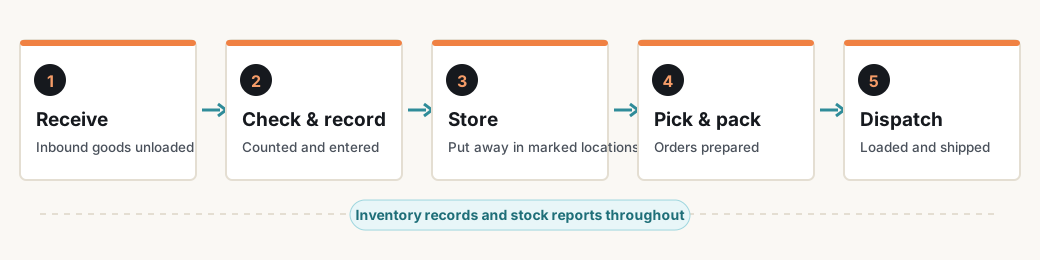
We can receive loads from your plant or suppliers, keep item-level stock records your planners can rely on, release material to the plant on call-off, and pick and dispatch finished goods to customers or distributors. Kitting of components, labelling, repacking and quality checks can be added, along with transport coordination and distribution warehousing when finished goods need to reach many destinations.
Starting an engagement
- Enquiry. Tell us what you make, what needs storing, where and why now, through our contact form.
- Requirement discussion. We cover material types, pack formats, weights, movement patterns and how stock will be called off to your plant or customers.
- Quote. Storage and your chosen services, priced on your real volumes rather than a generic rate card.
- Onboarding. Item codes, documents, receiving rules and contacts are agreed before the first truck arrives.
Frequently asked questions
Can you hold raw material and release it to our plant as needed?
Yes. A call-off process is agreed during onboarding so your planners can request material when production needs it.
Can you find space near our plant in another state?
That is the kind of request we handle. Tell us the location and requirement and we will look for suitable space.
Do you store chemicals or hazardous materials?
No. We can discuss dry, non-hazardous items such as new packaging, spares and project material.
Can you kit components before they go to the line?
Yes. Kitting, labelling, repacking and quality checks are available as value-added services.
Related reading
 Services
Chemical Warehousing: A Guide
A checklist for choosing chemical warehousing in India: safety data sheets, licences and approvals, segregation, fire readiness, monsoon risks and transport.
Read more → Services
Pharmaceutical Warehousing: A Guide
A step-by-step guide to choosing pharmaceutical warehousing in India: licences, temperature mapping through summer and monsoon, batch control and audits.
Read more → Services
Distribution Warehousing
Distribution warehousing across India: stock placed close to your dealers and customers, with order picking, cross-docking and transport coordination.
Read more →